
tl;dr
amec sources electronic components for manufacturers and industrial customers through a global supplier network. That used to mean: hundreds of emails a day, manual part classification, and institutional knowledge buried in individual inboxes. We built a platform that automates the entire procurement cycle with AI — from bill of materials to customer quote. The result: a team that makes decisions instead of managing admin.
The Challenge
amec is a mid-sized distributor for electronic components. Manufacturers and industrial customers bring their bills of materials (BOMs) to amec — amec handles the full sourcing through a global network of suppliers and partners. From first inquiry to delivery: customer → amec → supplier. Prototypes and large-scale production alike.
The process ran on email, Excel, and an ERP system that was never designed for this kind of orchestration.
Before anyone could even start sourcing, every part had to be classified manually — often hundreds of line items, often a full day's work. Then: writing RFQs, chasing responses, logging prices and lead times extracted from unstructured email text. A single project could generate hundreds of email threads.
Knowledge stayed invisible. Rejections, alternative parts, part crossings — all of it sank into individual inboxes. The same supplier could receive the same inquiry two months in a row, even if they'd already proven unsuitable. By the time a quote was ready, days had passed. In a market where the first credible offer often wins the deal, that lag had a direct cost.
What's changed isn't just the speed — it's the visibility. We can now see which partners actually perform on which parts, where margins are, where the risks are. That information used to disappear into email threads. Now we make decisions on data, not gut feeling.

The Solution
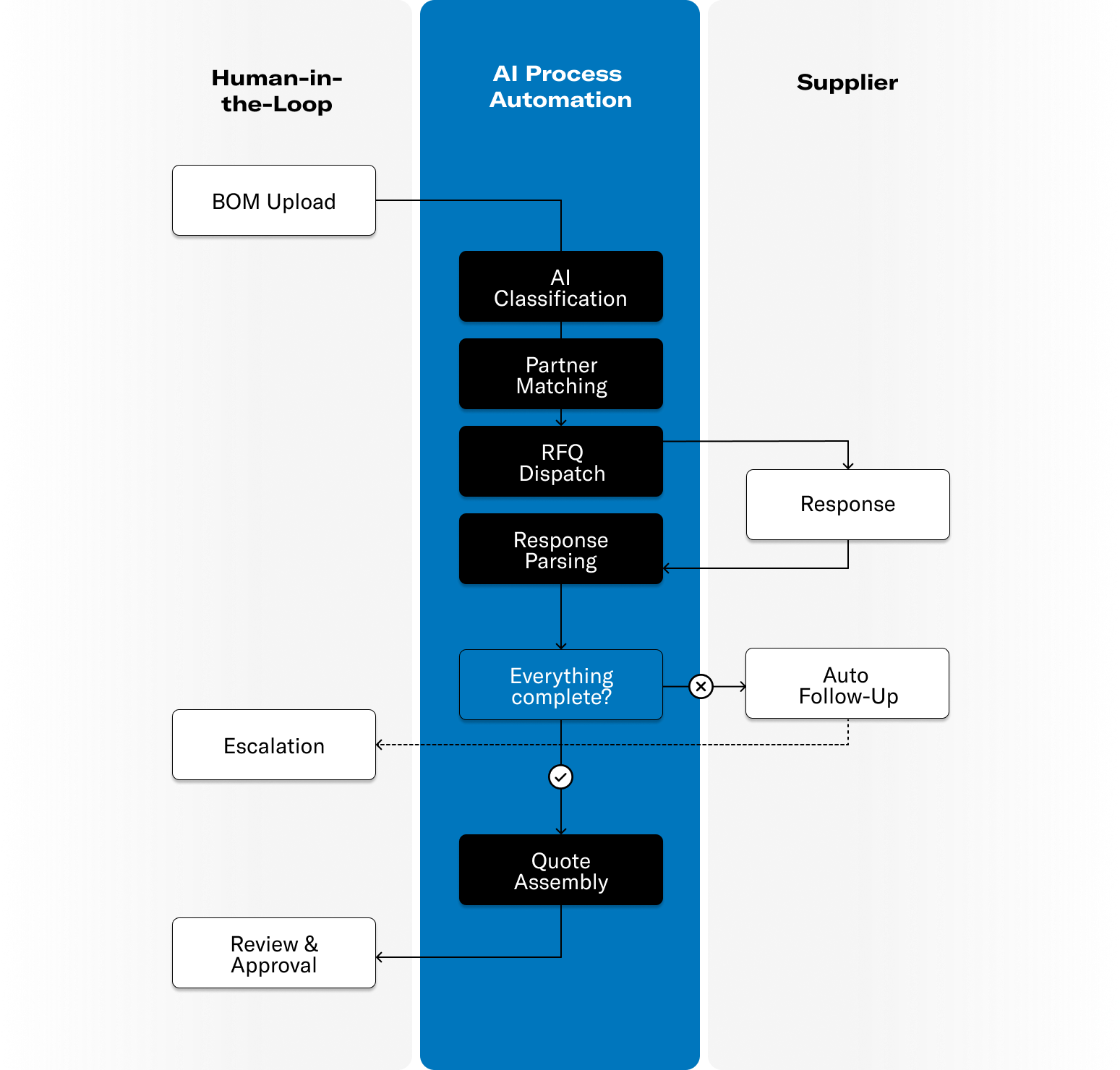
We built a sourcing platform from the ground up — a web application that digitizes and automates the full procurement cycle, from BOM upload to customer quote. At its core, it's an agentic workflow: AI-driven process steps hand off to each other, make decisions, escalate when needed, and pull humans in only where judgment genuinely matters.
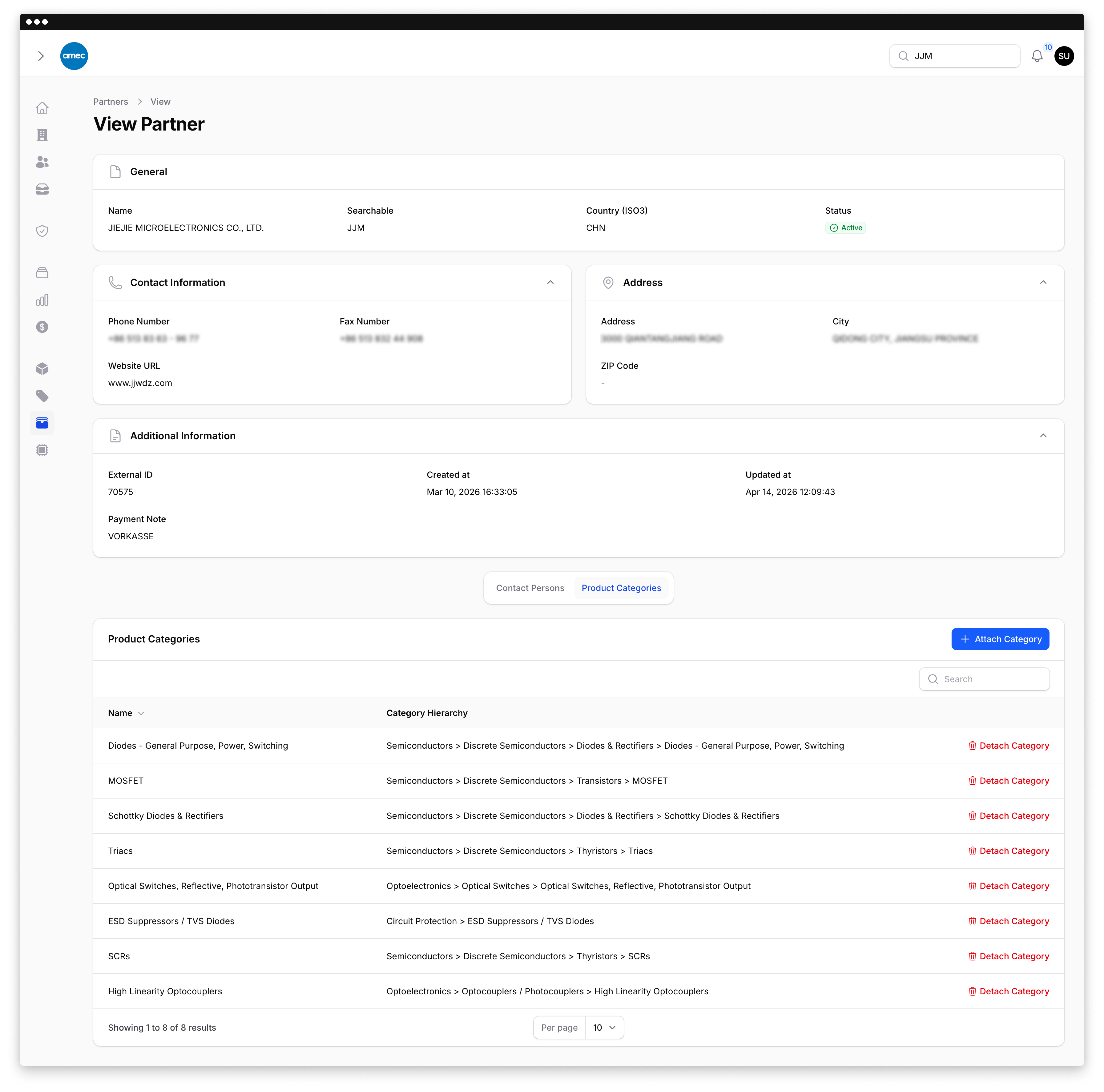
The platform runs on Laravel and Filament, hosted on Microsoft Azure. The central nervous system of the platform is the “DataKube” — amec's master data record. It consolidates structured information on parts, alternatives, partners, pricing, categories, and selected historical data, forming the shared knowledge base for all core processes and AI decisions.
Rather than blind automation, we built for controlled assistance. Every AI decision is traceable, auditable, and human-overridable. The system outputs confidence scores for every classification, falls back gracefully when uncertain, and keeps humans in the loop at moments that matter. The AI handles the repetitive work — so the team can focus on what actually requires judgment.
What the Platform Does
Automated BOM Processing
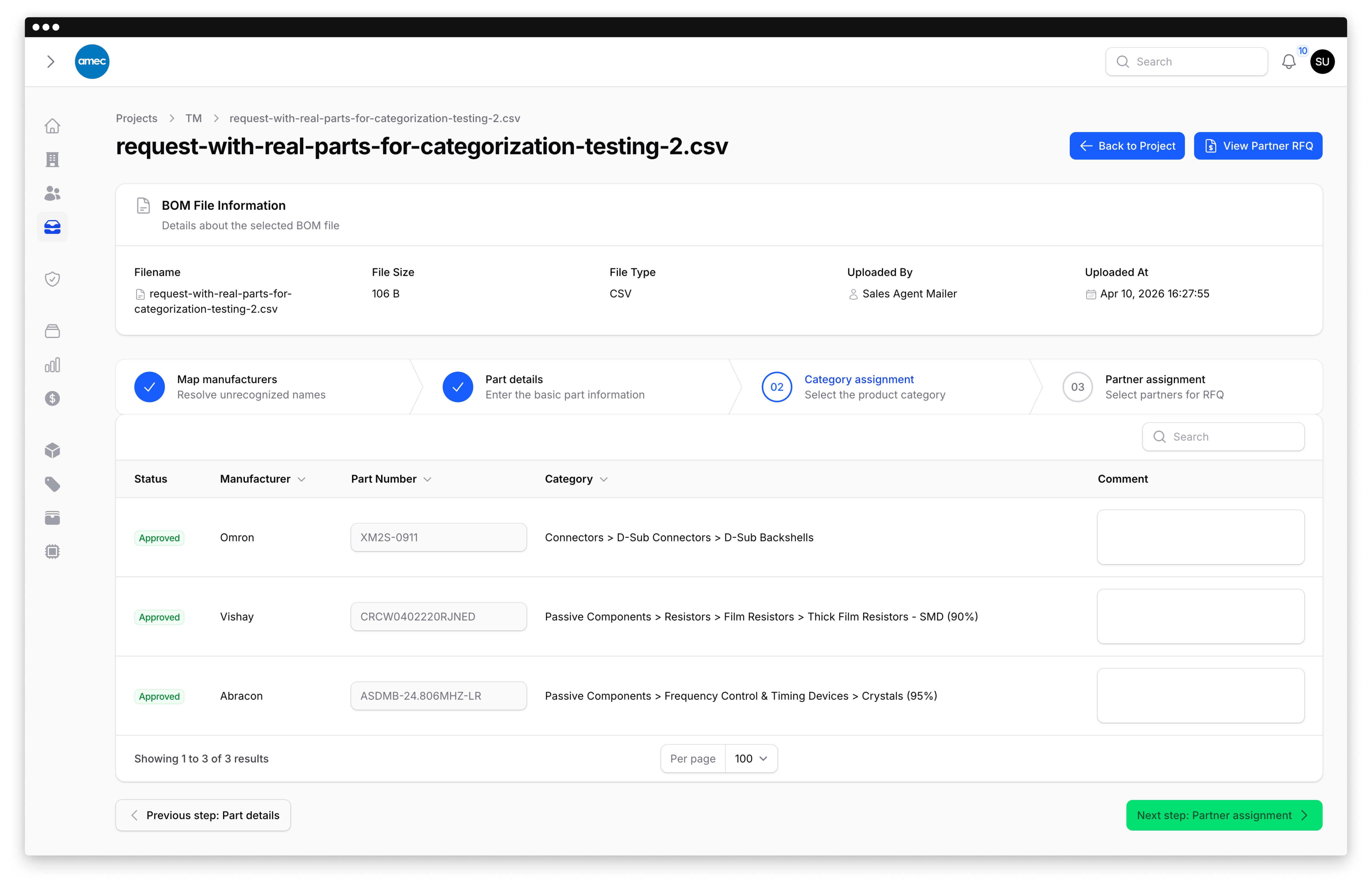
Sales staff upload Excel, CSV, or EML bill-of-materials files. The system parses and classifies every component automatically — first checking the DataKube, then via LLM. Every part lands in the DataKube with its classification and confidence score at the moment of upload, not days later.Intelligent Partner Matching & RFQ Dispatch
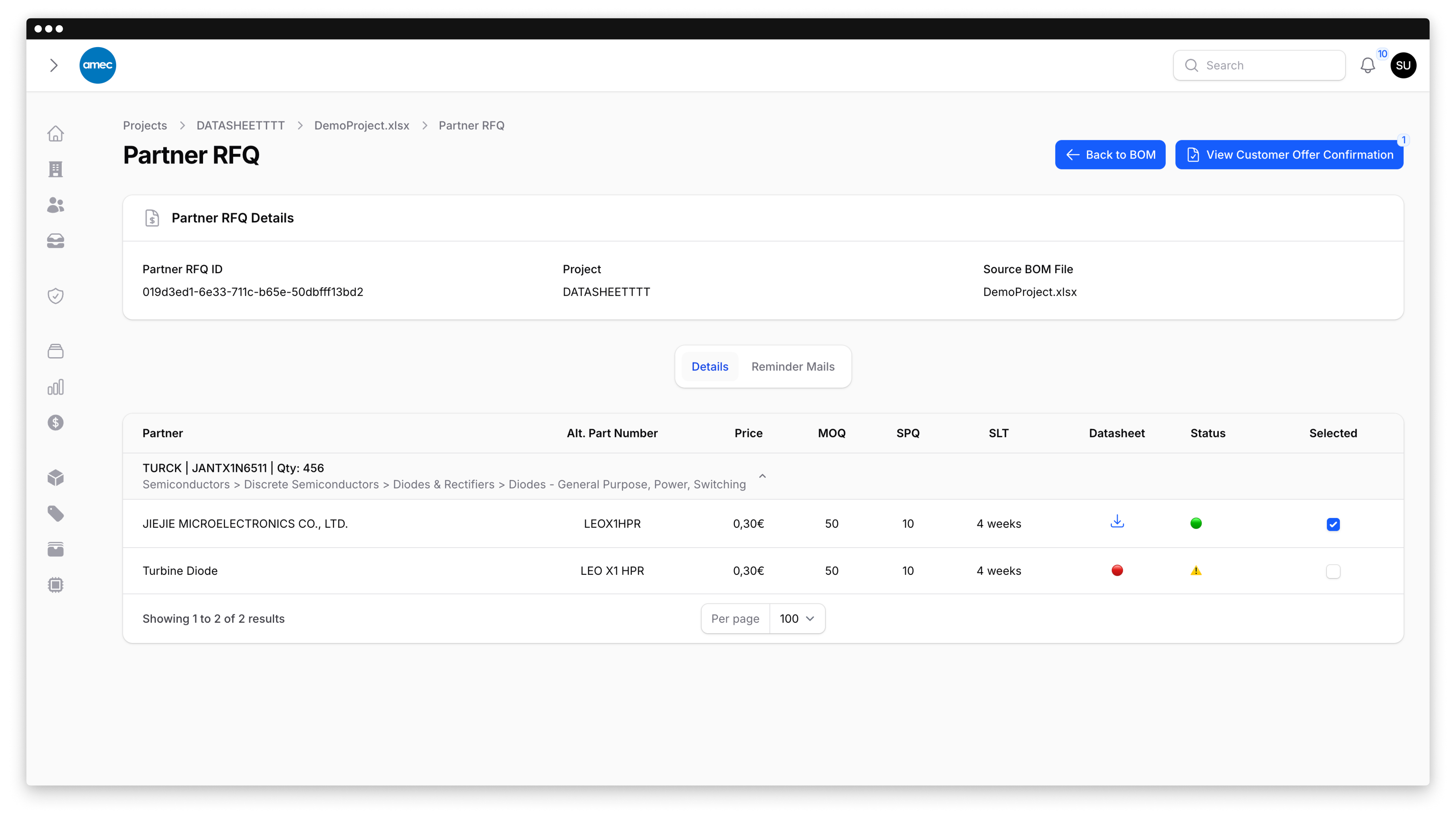
Based on product category, the system determines which partners to contact and sends RFQs directly — one per partner, covering all relevant parts. Partner-to-category mapping is LLM-driven and informed by historical order data.Agentic Email Workflow
Incoming partner responses are parsed automatically. The system extracts prices, lead times, MOQs, and MPNs from unstructured email text, flags rejections, identifies gaps, and fires targeted follow-up requests. If a partner doesn't respond, up to three automated follow-ups go out at configured intervals before a team member is notified. Zero manual prompting needed — from first outreach to escalation — but always with a human in the loop.Knowledge Base & Quote Assembly
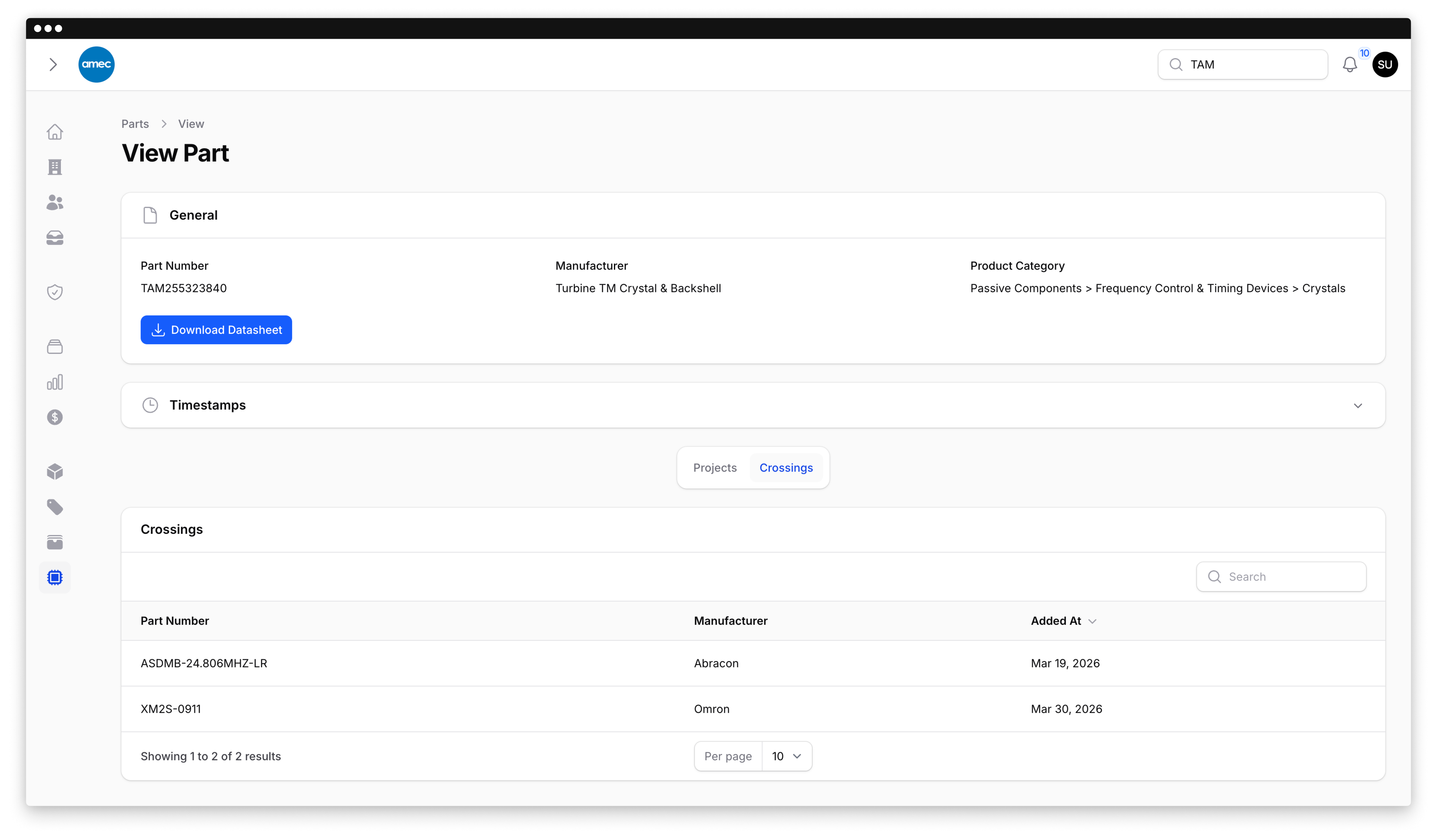
When a partner offers an alternative part, the system creates a cross-reference automatically. Attached data sheets are recognized, categorized, and stored. What used to live in people's heads and inboxes now grows in the DataKube into a searchable knowledge base. Users select the best offers and assemble a customer quote from them — with full traceability back to the original BOM line item.LLM Cost Controlling
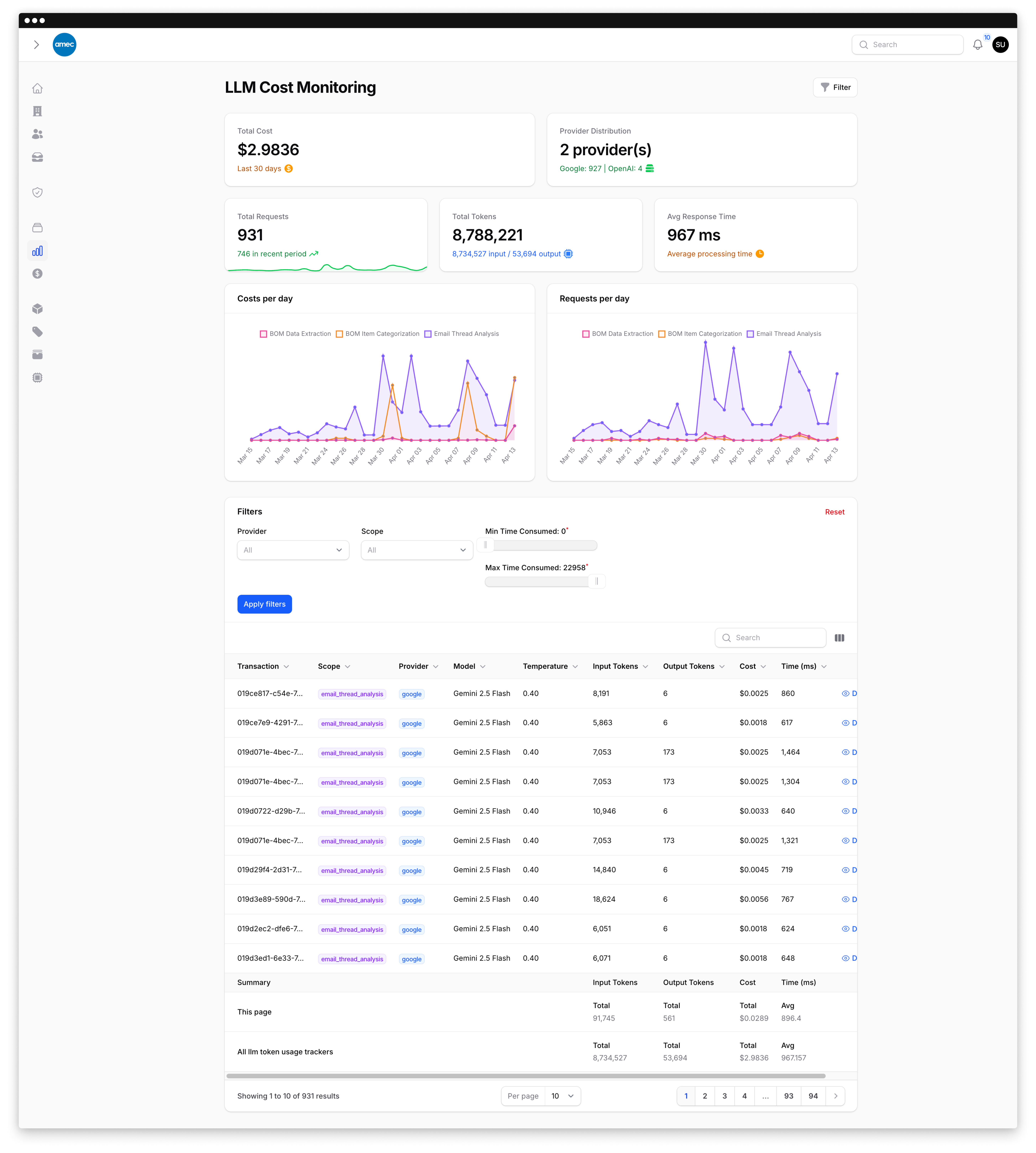
Every LLM call is tracked by model, use case, and volume. This creates transparency and enables targeted optimization — keeping AI economically viable as sourcing volume scales.
Our Work
This project demonstrates how we deliver tangible business value through AI Integration, AI Process Automation, and Agentic Workflows — and how we build production-ready systems that operate at the core of real business processes.
In a focused discovery phase, we identified technical risks early through AI-assisted prototyping: evaluating the tech stack, investigating the Microsoft Graph API, validating LLM classification — before a line of production code was written.
Architecture: Domain-Driven Design with clearly separated bounded contexts. Each domain can evolve independently as requirements change.
AI Integration: OpenAI and Gemini with fallback mechanisms, deployed for BOM classification and email analysis. Prompts are optimized per use case and coordinated across the workflow.
Infrastructure: Azure with Container Apps, PostgreSQL, Redis, and Blob Storage. CI/CD via GitLab. Built for production, with ERP integration as the next milestone.
Delivery: Kanban-based, continuous delivery to staging, sprint reviews with the client. The team covers AI/ML implementation, NLP, email integration, full-stack development, and cloud infrastructure.
Our development follows Agentic Engineering: we actively use AI within our own build process — to validate faster, catch risks earlier, and make architecture decisions with immediate feedback.

AI projects don't fail at the tech stage. They fail after. At amec, we've built from day one for what matters beyond a proof of concept: fallback mechanisms between models, LLM cost control, human-in-the-loop. That's how you build AI integration that lasts.

Matthias Gronwald
Co-CTO
Turbine Kreuzberg
The Impact
The results show up on three levels.
Efficiency. BOM classification happens at upload. Requests go out automatically, responses get parsed, follow-ups sent, escalations triggered. Staff step in at decision points — not at every single step. What used to take a full day per project now runs in the background.
Revenue and growth. In a market where the first credible quote often wins the deal, speed is a direct revenue lever. A faster turnaround from BOM submission to customer offer changes which contracts amec can realistically bid on — and how many run in parallel, without adding headcount.
Scale and profitability. Procurement knowledge accumulates inside the platform: part crossings, partner capabilities, data sheets, pricing history. The cost per request drops permanently — and margins improve because decisions are made on better data.
The capacity freed up flows where it makes a real difference: more complex projects, closer customer relationships, faster response to new markets.
What's described here is phase one. The collaboration continues — and the platform was built to grow with the business: ERP integration, automated margin calculation, direct customer access, and long-term a marketplace where partners bid on requests directly. Every next stage slots into an architecture designed for exactly that.
Ready for more?
Let's talk ideas, challenges, needs, and solutions.

- Daniel Ristig
- Director AI Consulting & Value Creation
- daniel.ristig@turbinekreuzberg.com
- +491607864647
- Let's meet