Agentic Engineering

Agents Code, Humans Decide

We build structured, human-in-the-loop development workflows where agents handle scaffolding, testing, and documentation. And engineers stay focused on the decisions that matter.

The gap between using AI tools and running an AI-first engineering team is wider than it looks.

Swapping in a code completion plugin changes very little. Restructuring how work gets researched, planned, and executed changes a lot. Agentic Engineering is how we build software today. 

Across client projects from commerce platforms to full website relaunches, our teams run an AI-first implementation model: agents drive the implementation, engineers drive the decisions. Delivery gets faster, quality gets more consistent, and every architectural decision has an audit trail.

What We Do

AI Development Workflows

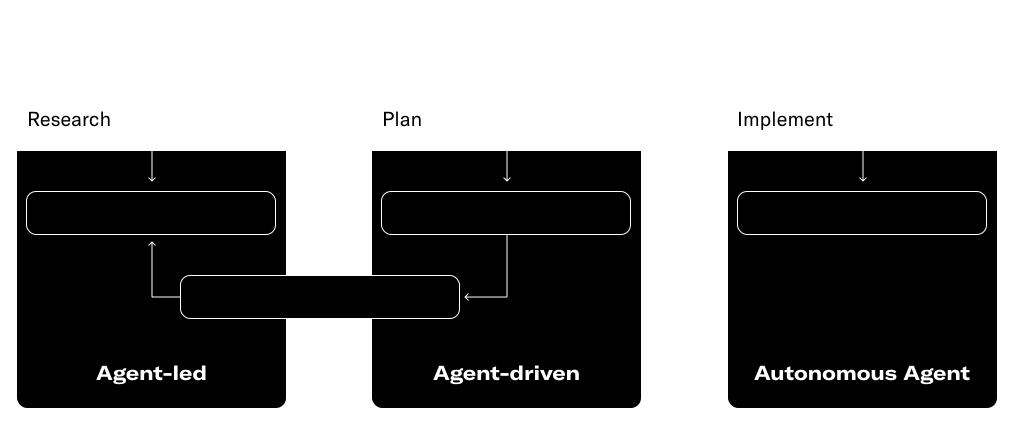
We replace ad-hoc AI usage with a repeatable cycle: Research, Plan, Implement. Every non-trivial feature starts with a documented analysis phase before any code is written. A sub-agent validates the plan for gaps and scope creep. Implementation runs phase by phase, with human sign-off at each checkpoint.
Team Enablement

We set up the agentic development workflow and hand it over. Your engineers get training on live tickets. We build the skills and commands for your stack, encode your conventions into the ruleset, and connect your tools. After that, the workflow runs without us.

Custom Skills and Commands

Generic AI tooling doesn't know your codebase, your framework conventions, or your team's definition of done. We build project-specific skills — for static analysis, test generation, code review, and branch management — that encode your standards and run them automatically.

Tooling Integration

We connect Claude Code to your existing tools: Jira, GitLab, Confluence, your database, your CMS, your Figma files. Development context lives in the workflow, not in someone's head. Agents fetch ticket context, run queries, push to registries, and open merge requests without leaving the terminal.

AI-Assisted Code Review

Before code is committed, an agent reviews the diff for logic errors, performance issues, missing tests, and style violations. It handles branch naming, commit messages, rebasing, and pushing. Engineers review the findings, not the boilerplate.

Specialized Sub-Agents

For framework-specific work — Spryker module generation, migration analysis, pipeline diagnostics, test impact assessment — we build focused sub-agents that know the domain and stay within defined boundaries.

Governance and Safety Rules

AI has no access to production systems. Deployment actions require explicit human approval. All generated code goes through standard review before merge. These rules live in the project configuration, not just in team agreements.

Here's how we work

We start every project by defining an AI ruleset: coding conventions, architectural boundaries, test requirements, and tool permissions. These live in the instruction file that every agent reads before doing anything. The ruleset travels with the codebase and applies across the whole team.

Work runs in phases. Research surfaces decisions before implementation begins. Planning produces a structured, checkbox-driven plan that a second agent validates for completeness before engineers approve it. Implementation follows the plan phase by phase, with progress tracked in a file that also serves as the handover document. Engineers sign off at every checkpoint. Nothing deploys without a human decision.

We've run this on greenfield projects and on legacy codebases. It works in both directions.

The most interesting engineering work has always been architectural. With our agentic approach, that's where we put our focus, allowing us to produce visible results much faster.
Thomas Kühnel

Thomas Kühnel

Co-CTO

Turbine Kreuzberg

AI Tech Stack

Use Cases

You're running a composable commerce project and want faster, more consistent delivery.

We set up the full RPI workflow alongside commerce framework-specific agents that know facade patterns, transfer objects, and module architecture. Custom skills handle test generation and static analysis automatically.

You're relaunching and want to go from Figma to production without losing fidelity.

We connect Figma, your CMS, and Claude Code via MCP servers. Agents extract exact design specs, generate components, and register them in server and client registries. Every component has a styleguide entry before it ships.

Your engineering team has adopted some AI tools but not a structured workflow.

We audit your current setup, define the AI ruleset with your team, build the skills and commands that fit your stack, and run the team through the RPI cycle. The workflow stays with you after the engagement.

Let's get agentic

Tell us where your team is now, and we'll figure out where agentic workflows fit.

Timothy Becker